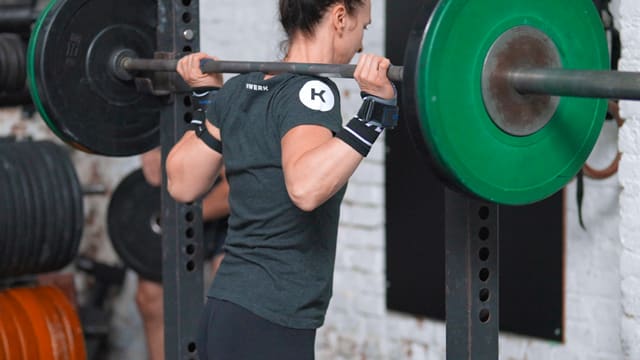
Part 1: Back Squat
Rounds for Quality
Progression- Back Squat
- Rest
Beginner Strength Training
60-day money-back guarantee. Register online, download the app and start training.
 Video: About this plan
01Description
To help you get off to a strong start at the gym: A classic strength training plan for the gym—specially designed for beginners with no prior experience. No fancy machines, no complicated exercises. Just the basics that really work. You’ll work out 2 days a week. Throughout this plan, you’ll get comfortable with the basic barbell exercises and build a solid foundation of strength within 6 weeks. We’ll explain all the exercises in our pre-workout videos.
02Overview
At a glance
Focus
AI & Progression
36 blocks use Progressions, with prescribed weights, equipment and training conditions to make each session as effective as possible.
03Training days
Each training day is divided into blocks. The app shows your reps, intensity and weights. AI Workouts are shown here as RX — the original version. In the app, AI adapts them to your level and equipment.
Rounds for Quality
ProgressionRounds for Quality
ProgressionRounds for Quality
ProgressionRounds for Quality
ProgressionRounds for Quality
ProgressionRounds for Quality
ProgressionRounds for Quality
ProgressionRounds for Quality
ProgressionRounds for Quality
ProgressionRounds for Quality
ProgressionRounds for Quality
ProgressionRounds for Quality
ProgressionRounds for Quality
ProgressionRounds for Quality
ProgressionRounds for Quality
ProgressionRounds for Quality
ProgressionRounds for Quality
ProgressionRounds for Quality
ProgressionRounds for Quality
ProgressionRounds for Quality
ProgressionRounds for Quality
ProgressionRounds for Quality
ProgressionRounds for Quality
ProgressionRounds for Quality
ProgressionRounds for Quality
ProgressionRounds for Quality
ProgressionRounds for Quality
ProgressionRounds for Quality
ProgressionRounds for Quality
ProgressionRounds for Quality
ProgressionRounds for Quality
ProgressionRounds for Quality
ProgressionRounds for Quality
ProgressionRounds for Quality
ProgressionRounds for Quality
ProgressionRounds for Quality
Progression04Exercises
Our coaching team selected these exercises for your plan. If you need to swap one, we’ll suggest alternatives.
05Details
Are you new to the gym or want to get started safely with free weights? This 6-week workout plan guides you step by step through key basic exercises at the gym. With two sessions per week, you’ll build a solid foundation, learn proper form, and develop a better sense of weights, rest periods, and effort. Afterward, you can switch to classic Kernwerk® training plans or the Daily Workout—depending on your goals. You can repeat this plan as many times as you like. As a beginner, this plan can deliver great results for you over the long term.
Each session consists of three exercises. The focus is on free weights, particularly barbell training, supplemented by pull-up variations and appropriate modifications. The exercises have been deliberately chosen to be simple so that you can repeatedly practice the most important movement patterns: squats, lifts, presses, and pulls.
All sets are performed in “For Quality” mode. This means you’re not training against the clock, but rather focusing on clean repetitions. The time cap simply gives you a time frame. If you need more rest, take it, and then continue at a controlled pace.
You’ll train twice a week using a full-body workout routine. Both sessions target the major muscle groups, but with different focuses. There should be at least one to two rest days between training days to allow your muscles, joints, and nervous system to recover. Additional workouts are optional and shouldn’t interfere with your recovery.
Alternatively, you can also work out 3 times a week if you notice that your body handles the workout particularly well and you start each session with more or less no muscle soreness.
The plan runs for six weeks, with two training days per week. Each session lasts about 45 minutes of actual training time. The volume is intentionally manageable so that you can build a routine, refine your technique, and gradually work your way up to heavier weights.
In this plan, many of the exercises come with a specified rep range. This means you shouldn’t always aim for a fixed number of reps, but rather increase your reps step by step within that range. Once you’ve completed all the reps at the upper end of the range, you can increase the weight. Here’s how it works:
Example: 10–12 back squats at an RPE of 8.
Start with a weight that allows you to cleanly complete the lower end of the range—in this example, 10 repetitions. If that goes well, stick with the same weight during your next workout and aim for 11 repetitions. If that goes well too, aim for 12 repetitions next time.
Only after you've consistently completed the top end of the range in every set should you slightly increase the weight during your next workout. After that, start again at the bottom end of the range.
In short:
→ Increase the number of repetitions first
→ Then increase the weight
→ Then start again at the bottom of the range with the new weight.
This is how you'll get stronger without overdoing it. You don't have to use more weight in every workout. Especially in the beginning, it's just as valuable if an exercise feels more controlled, stable, or safe.
The RPE data
RPE helps you choose the right weight. RPE describes how heavy a set feels and how many clean reps you would still have in reserve. At an RPE of 8, you should still be able to complete about 2 clean reps at the end of a set. So if the guideline is 10–12 reps at an RPE of 8, you shouldn’t push yourself to the absolute limit. The set should be challenging, but your form should remain technically sound.
How strenuous can it get?
Your workout should be challenging. You should work hard, sweat, and feel your body being pushed to its limits. At the same time, keep this in mind: If your form, body tension, or control noticeably deteriorate, the weight was too heavy, or you need more rest. Breaks are allowed. Take them when you need them. But use them wisely: as few as possible, as many as necessary.
Set 1: 10 repetitions with proper form in all 3 sets (rounds).
Set 2: 11 repetitions with the same weight in all 3 sets (rounds).
Set 3: 12 repetitions with the same weight in all 3 sets (rounds).
Unit 4: Increase the weight slightly and start again with 10 repetitions.
As a rough guide, you can increase the weight by about 5 kg for squats and deadlifts. For upper-body exercises like the bench press, strict press, or row, 2.5 kg is often enough. If that feels too heavy, stick with the old weight or increase it by a smaller amount.
RPE Guide:
RPE 10 means: no more clean repetitions are possible.
RPE 9 means: about 1 clean rep left in reserve.
RPE 8 means: about 2 clean reps left in reserve.
During the last week, you’ll work your way up to your realistic 10 RM. That’s the weight at which you can perform 10 clean repetitions. Here, too, form is more important than weight. Only lift as much as you can while maintaining stable control of the movement.
You'll need standard gym equipment: a barbell, a squat rack, a weight bench, a pull-up bar, and ideally a resistance band. Enter all of your available equipment into the app. If you're not yet comfortable with certain exercises, that's no problem—the app can select suitable variations and modifications.
The breaks between training days are an important part of the plan. Strength training puts a strain not only on your muscles but also on your coordination, joints, and nervous system. Light exercise, mobility work, or low-intensity cardio can be beneficial on rest days, as long as they don’t compromise your next session. As for nutrition, you don’t need to worry too much about it (yet) at the beginning. Just make sure your diet is high in protein and well-balanced. We can dive deeper into the details of nutrition later on as you continue your fitness journey. For now, this rule of thumb will suffice: Include one serving of protein (meat, fish, tofu, seitan), one serving of vegetables (broccoli, cauliflower—whatever you like), and one serving of carbohydrates (potatoes, rice, pasta) in every meal.
Train with proper form and progress gradually. The goal isn't to lift heavy weights as quickly as possible, but to build a solid foundation. Good form, a genuine sense of effort, and controlled progression will take you further in the long run than forced personal bests.
06Membership
A new workout every day, adapted to your level and equipment. Plus beginner plans and Welcome Classes.
–
Price currently unavailable
See membership options and prices
Sign up online, get the app and start training with a 60-day money-back guarantee.
Start plan60-day money-back guarantee. Register online, download the app and start training.